
Guide
Driving lights
Last reviewed
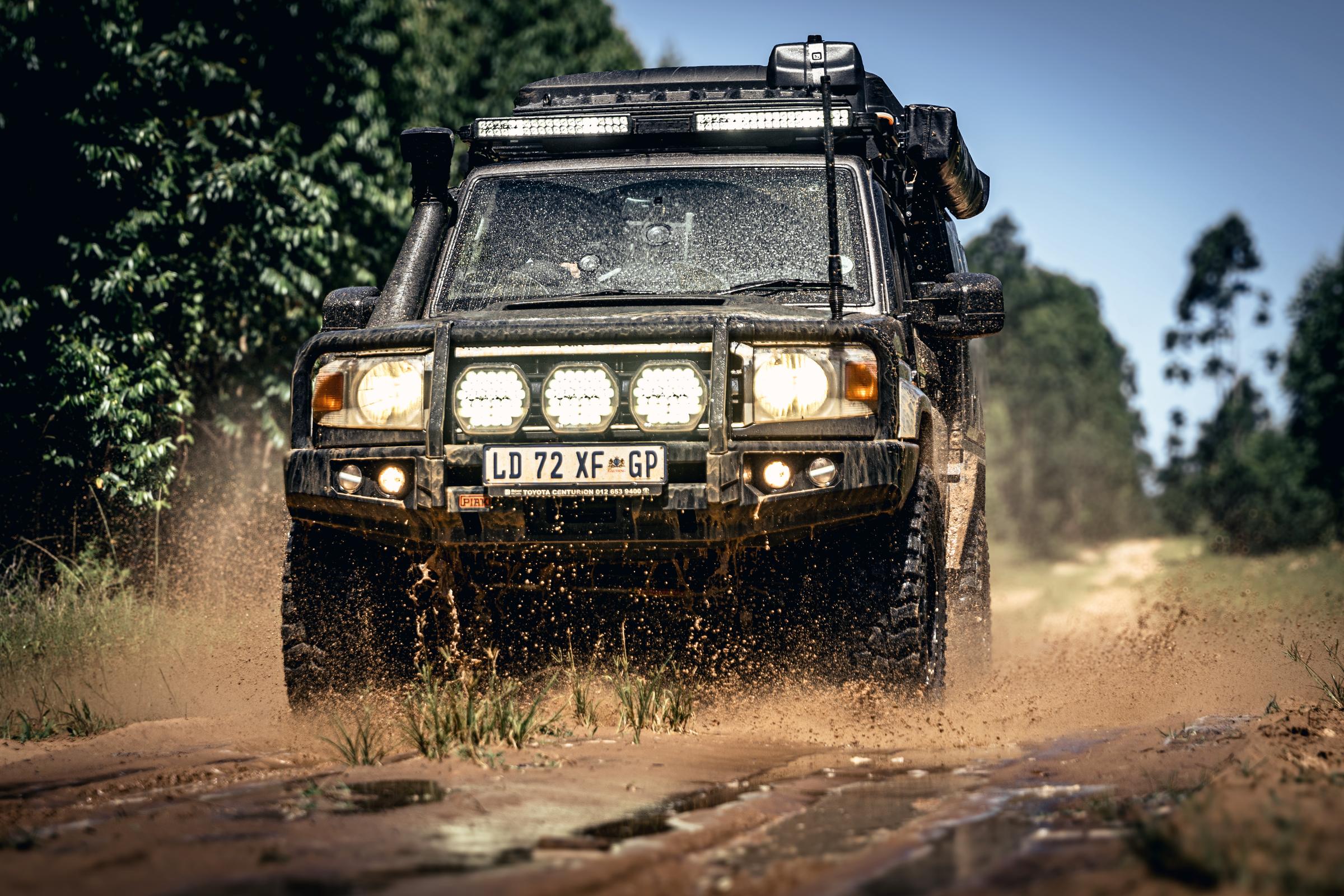
The case for them on South African roads is simple. Gravel, wildlife and long distances between towns after dark. Standard headlights were designed for none of those.
What driving lights are for
Your headlights do two jobs: a dipped beam that lights the road without blinding anyone, and a main beam for when the road is clear. Driving lights add to the main beam. They push useful light further ahead and wider to the sides, which buys you time.
Time is the whole point. At 100 km/h you cover about 28 metres every second. Light that reaches 500 metres gives you around 18 seconds of warning. Light that reaches 150 metres gives you about five.
They are not fog lights. Fog lights sit low, throw a wide, flat beam close to the vehicle, and have their own rules. Putting an amber filter on a driving light does not make it a fog light.
Spot, flood and combo

The pattern of the beam matters more than how bright it is.
Spot. A narrow, long beam. Maximum distance down the road, very little to the sides. Good for long straight gravel and open tar at night.
Flood. A wide, short beam. Lights the verges and the area close in front and to the sides. Good for slow, twisty tracks and for working around the vehicle.
Combo. A spread between the two. Long reach down the middle with some light on the shoulders, where animals come from. For most South African touring, a combination is what people end up wanting.
Many round driving lights, including the Lightforce range we carry, ship with a spot pattern and take clip-on filters that widen the beam. So the choice is not permanent. Some newer lights let you switch between patterns from the cabin.
Why lumens mislead, and what to compare instead
Lumens measure the total light a lamp produces. They do not tell you where that light goes.
It gets worse. Some brands quote raw lumens: the theoretical maximum of each LED multiplied by the number of LEDs. What actually comes out of the lens, after heat, optics and the lens itself, is lower. Lightforce publishes both figures and calls the measured one effective lumens. The gap is typically 10 to 25 percent and can be much more.
Compare 1-lux distance instead. One lux is roughly enough light to read a newspaper by. The 1-lux distance is how far down the road a lamp still delivers that much light. It tells you how far you will actually see.
Three things to check when you compare:
- 1 lux, not a lower figure. Some makers quote the distance to 0.25 lux, which is a much bigger number for the same lamp. Compare like with like.
- A pair or a single lamp. Manufacturers usually quote distances for a pair. Make sure both lamps you are comparing are quoted the same way.
- Independent testing. A photometric report from a test laboratory is worth more than a claim on a box.
Colour: white, neutral or amber
Colour temperature is measured in kelvin. Lower numbers are warmer, higher numbers are bluer.
Most quality LED driving lights sit around neutral white, somewhere between 5000K and 5700K in the current Lightforce range. That is close to daylight, which is the point: it shows colours and surfaces the way your eyes expect. Very cold, blue-white light tends to bounce harshly off reflective signs, pale gravel and anything in the air.
Amber and yellow. The regulations allow white, amber or yellow light facing forward. Many drivers find amber easier on the eyes, particularly in dust, and it is popular around camp. What we will not tell you is that amber cuts through fog: peer-reviewed research on light in fog found that the scattering is largely unaffected by colour. In thick fog, more light of any colour is not the fix. Slowing down is.
Never red, green or blue forward on a public road. Red and green filters are for hunting on private land, and the road regulations allow only white, amber or yellow towards the front.
LED, halogen or hybrid
LED. Efficient, very long-lived, instant on, and far more resistant to vibration than a filament. This is where almost all development now happens.
Halogen. Warm, cheap to replace, still sold. Draws more power for the light it gives and the bulbs wear out.
Hybrid. Combines a high-intensity discharge (HID) source for long reach with LEDs for spread close in. Built for very long throw.
Whatever you choose, look at the current draw. Lights are an electrical load like any other, and a large pair on a long night drive is a real one. Your harness and fuse have to be rated for it.
Waterproofing and the IP rating
The IP rating tells you how well a light keeps out dust and water.
- The first digit is dust. 6 means dust-tight, which is what you want on gravel.
- IP67 means it survives temporary immersion.
- IP68 means it survives continuous immersion to conditions the manufacturer specifies.
- IP69K means it survives close-range, high-pressure, hot water jets. It comes from an automotive standard, and it is the one that matters if you pressure-wash the vehicle after a trip.
IP67 and IP68 do not cover a pressure washer. If you wash the vehicle that way, look for IP69K.
Wiring them properly

This is where most driving-light problems come from, and most of them are avoidable.
A proper harness. High-powered lights should draw their power straight from the battery through a fused, heavy-duty harness, switched through a relay. The switch on the dashboard carries only a small current to the relay. The relay handles the load.
A fuse at the battery. Rated for the lights and no higher than the cable can carry.
A switch you can reach. Many vehicles have blank switch positions in the dash, and factory-style switches are made to fit them. On some models there are fascia panels made for the purpose.
The high-beam trigger. Most harnesses connect the relay to the vehicle’s high-beam circuit, so the driving lights come on only with main beam and go off the moment you dip. On newer vehicles the high-beam signal runs through the vehicle’s computer network, and cutting into factory wiring can cause fault codes. Vehicle-specific plug-in harnesses that connect behind the headlight exist for exactly this reason.
Check your sensors. Many new vehicles have a radar or camera behind the grille for adaptive cruise control and collision avoidance. A driving light mounted in front of one can block it. Mount lights where they leave the sensors clear, and choose a lamp size that allows that.
Radio interference. Cheap LED drivers can cause interference on the radio. Better lights are tested against an automotive interference standard.
Your fitment centre fits and aims these every day, and will know what your specific vehicle needs.
The legal position
We are having the South African regulations on auxiliary lights checked by a legal reviewer before we publish our summary. Until then, the safe rules are simple: driving lights are main beam and go off when you dip, only white, amber or yellow light may face forward, and roof bars stay off on a public road.
Choosing, in one minute
- Mostly tar and fast gravel, long straight roads: long-reach spot or hybrid, with a combo filter for the shoulders.
- Mixed gravel, farm roads and animals on the verges: combo pattern, or a lamp with switchable modes.
- Slow tracks and camp work: a flood pattern or a work light, which is a different product.
- Low bumper or a sensor behind the grille: a smaller, slimmer lamp mounted where it leaves the sensor clear.
- Pressure-washing after trips: IP69K.
Talk to someone who fits this for a living
Mounting, aiming and wiring are what make driving lights work, and they are what make them legal on the road. A fitment centre partner will match the lights and the harness to your vehicle, keep the sensors clear and aim them properly.
FAQ
Frequently asked questions
What is the difference between spot, flood and combo beams?
A spot beam is narrow and long, for distance. A flood beam is wide and short, for close-in and to the sides. A combo mixes the two, with long reach down the middle and light on the shoulders, which suits most South African touring.
Are more lumens better?
Not necessarily. Lumens measure total output, not where it goes, and some brands quote theoretical rather than measured figures. Compare the 1-lux distance instead, for the same number of lamps, ideally from an independent test report.
Does amber light cut through fog?
Not better than white. Research on light in fog found scattering is largely unaffected by colour. Many drivers find amber easier on the eyes in dust and around camp, and it is allowed facing forward, but in fog the answer is to slow down.
Do driving lights have to be wired to high beam?
South African law requires your main beam to go off when you dip, and driving lights are main beam. Wiring them to the high-beam circuit is the usual way to achieve that. The rule that they must be wired to high beam by law is Australian.
What IP rating do I need?
IP67 or IP68 keeps out dust and water immersion. If you pressure-wash the vehicle, look for IP69K, which is tested against close-range, high-pressure hot water jets.
Last reviewed