
Guide
Tyre pressures for South African conditions
Last reviewed
If you only remember one thing from this page, make it that last sentence.
Why deflating works
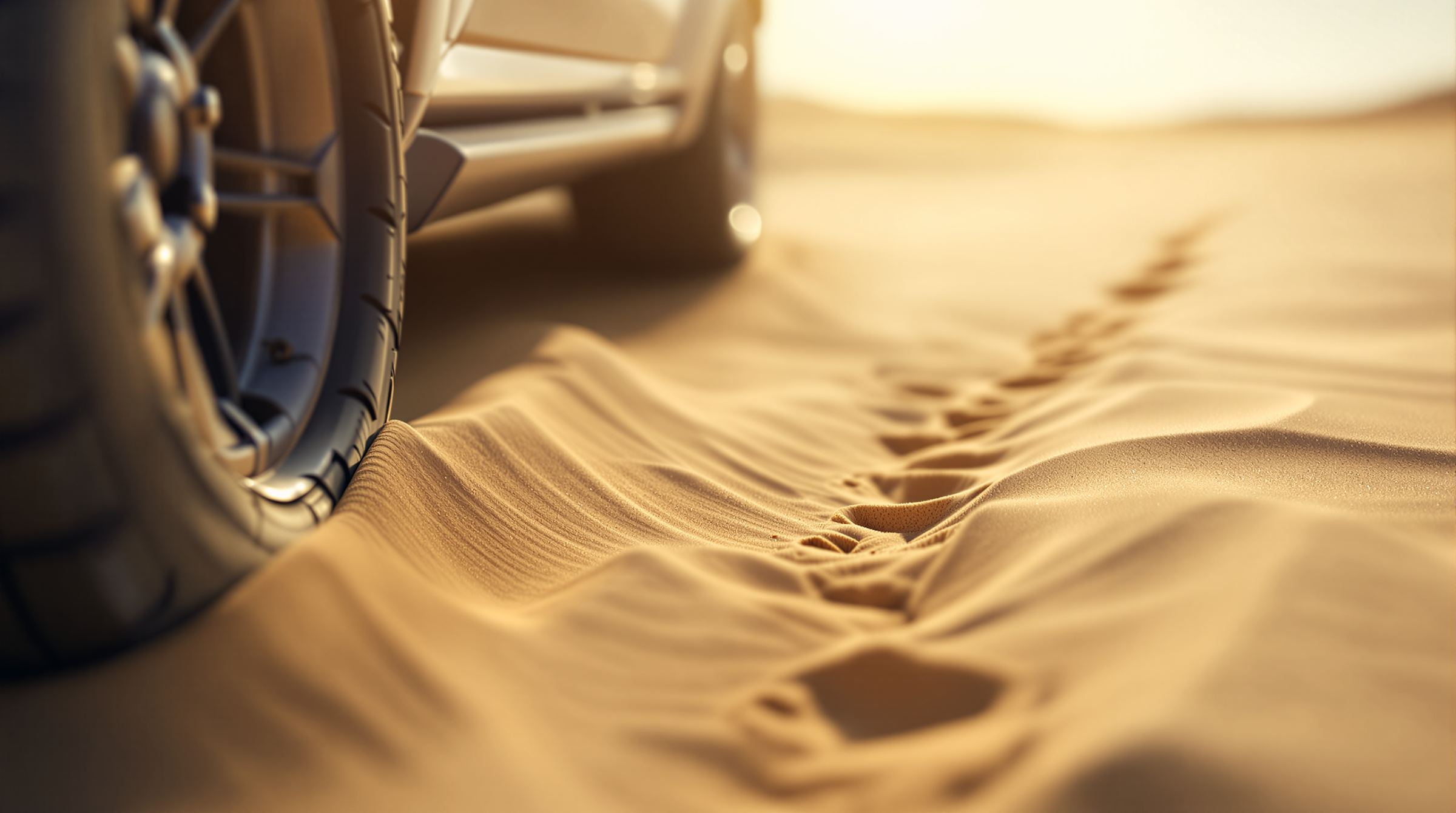
A tyre at road pressure is short and round where it meets the ground. Drop the pressure and the contact patch gets longer, not much wider. That longer footprint spreads the vehicle's weight over more ground, so the tyre rides on top of soft sand instead of ploughing a trench into it. It also lets the tread conform over rock and roots instead of bridging across them, which is why a deflated tyre finds grip a hard one cannot.
Three things get better: flotation, grip, and ride comfort over corrugation. Two things get worse: the sidewall flexes more and builds heat, and the tyre becomes easier to roll off the rim under a hard steering input.
That trade is the whole subject. Everything below is about managing it.
Interactive · Fig 3
Air down
What happens to the footprint and the sidewall as you let air out for sand, one published step at a time.
What published guidance actually says
Manufacturer guidance for this market is thinner than you would expect, and it is worth quoting precisely rather than paraphrasing.
Published guidance
- BFGoodrich's Africa guidance for sand: drop pressures by 0,3 bar at a time until you reach the footprint you need. Do not drop below 1,4 bar. At 1,4 bar, do not exceed 25 km/h.
- BFGoodrich's Africa guidance for mud: do not go below 20 psi, and do not travel faster than 20 km/h.
- Their own caveat, on the same page: there is no optimal tyre pressure, because every situation and terrain requires a different pressure.
Source: BFGoodrich Africa, published off-road tyre pressure guidance.
For gravel and for rock, we could not find published manufacturer figures for this market that we are willing to reproduce. Anyone quoting exact numbers for those surfaces is quoting a personal preference. That may still be good advice from an experienced traveller, but it should be labelled as what it is, and we would rather tell you that than invent a table.
What we can tell you about gravel is directional and comes from the physics rather than a published figure. A modest reduction from road pressure improves ride and grip on corrugation and reduces the hammering that loosens everything in the vehicle. A large reduction at gravel speeds is how sidewalls get destroyed, because gravel speeds are high and the heat has nowhere to go.
The rule that matters more than the number
Safety
Pressure down, speed down. Proportionally, and without arguing about it.
A deflated tyre run at road speed overheats. The sidewall flexes through a bigger arc thousands of times a minute, the rubber and the casing heat up, and the tyre fails. That failure is usually sudden and it usually happens on the sidewall, not the tread.
There is a regulation behind this too. In South Africa you may not operate a vehicle at a speed exceeding the speed specified for the tyre fitted, in the applicable standard specification or as approved by the tyre manufacturer. And for what it is worth at a roadside check, the regulations expressly say that in determining the pressure in a tyre, the temperature of the tyre is disregarded. You cannot argue that they were hot.
Reinflate before you get back on tar. Not at the next town. Before the tar.
Load is the missing variable
Almost every tyre pressure conversation ignores the thing that changes the answer most: how heavy the vehicle actually is.
Your placard pressure assumes a certain load. A fully kitted touring rig carries hundreds of kilograms more than the vehicle it started as, and most of that lands on the rear axle. The rear tyres of a loaded bakkie may need more pressure than the placard on tar, not less, and they will need a different starting point off-road than the fronts.
There is a legal dimension here as well as a practical one. The regulations prohibit operating a vehicle where any wheel massload exceeds the figure specified for the tyre fitted in the applicable standard. A tyre's load capacity is pressure-dependent. So a heavily loaded, under-inflated vehicle is not only unstable, it can put you outside the regulation.
The practical consequence: weigh the vehicle loaded, at least once. A public weighbridge ticket turns every tyre pressure conversation from guesswork into arithmetic, and it does the same for your suspension specification.
A rule of thumb, honestly labelled
You will hear the four psi rule repeated on forums and at campsites. The method is to note your cold pressure, drive for a while, then measure again. If the pressure has risen by about 4 psi, the tyre is said to be working about right. A much bigger rise suggests you started too low and the tyre is building excess heat. Much less suggests you are running harder than you need to.
This is a workshop rule of thumb, not manufacturer guidance and not a standard. It assumes a fairly constant speed and surface, it is affected by ambient temperature and by sun on one side of the vehicle, and it tells you about heat rather than about flotation. Treat it as one input among several, not as an answer.
Getting the air back in
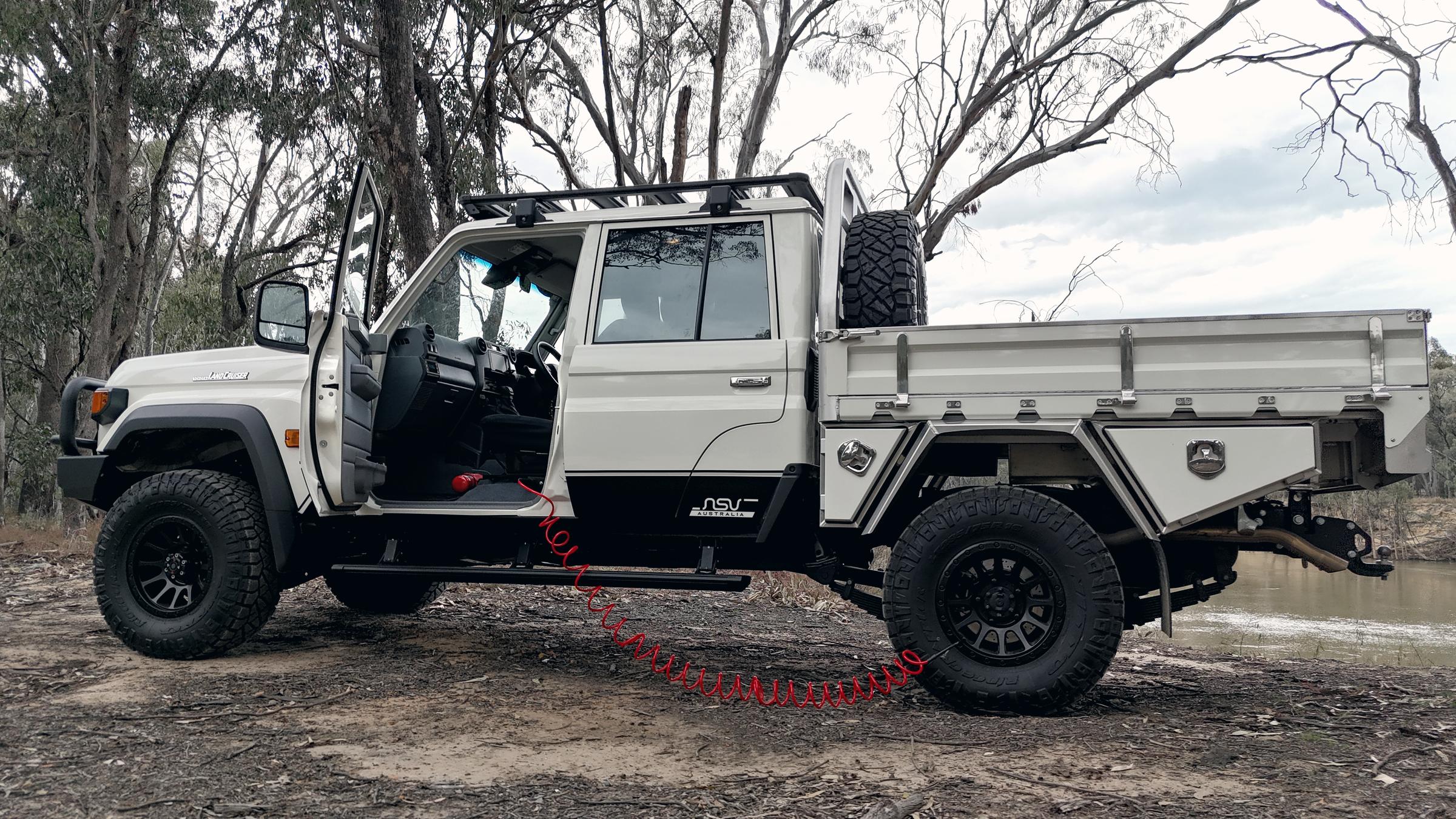
The compressor is the most-used piece of recovery equipment most people own, and the one they buy last.
Think of it as part of the tyre system rather than as an accessory. If deflating is the technique that gets you through most soft ground, then a compressor is what makes that technique usable, because without one you either drive to the next town on soft tyres or you do not deflate in the first place.
Two things worth knowing when you choose one. Duty cycle matters more than headline flow rate, because you will typically be reinflating four tyres in sequence in the heat. And a deflator that lets you drop several tyres at once, or a gauge you can read in low light, saves more time than a faster pump.
All-terrain or mud-terrain
For almost every reader of this page, all-terrain.
Mud-terrains are quieter than their reputation on modern compounds, but they wear faster, cost more, and are worse in the wet on tar, which is where you will spend most of your kilometres. They earn their place in sticky clay and in mud deep enough that an all-terrain packs solid and stops clearing.
Buy mud-terrains when you have established, from your own experience, that all-terrains are the thing stopping you. Not before.
The more useful question for most people is not the tread pattern but the construction. A tyre with a stronger casing resists sidewall damage on sharp rock and gravel, which is the single most common way a touring tyre dies in this part of the world.
Work out a starting point
We built a planner that takes your vehicle's laden mass, your tyres and the surface you are heading onto, and gives you a starting point, the published floor for that surface where one exists, and the speed ceiling that goes with it.
It gives you a starting point, not an answer. You still check the footprint, and you still adjust.
Get this checked properly
Your fitment centre can read your tyres' load table against your actual weighbridge figures, which is the only way to turn all of this into numbers specific to your vehicle. More than 500 independently owned fitment centres across six countries.
FAQ
Frequently asked questions
What tyre pressure should I use in sand?
There is no single correct figure. BFGoodrich's published guidance for this market is to drop by 0,3 bar at a time until the tyre floats rather than digs, not to go below 1,4 bar, and not to exceed 25 km/h at that pressure. Your correct starting point depends on laden mass, tyre size and construction.
How low can I safely go?
Follow the manufacturer's published floor for the surface where one exists: 1,4 bar for sand and 20 psi for mud, per BFGoodrich Africa. Below that you risk rolling the tyre off the rim under steering load. Lower pressure always means proportionally lower speed.
Do I need to deflate on gravel?
A modest reduction improves ride and grip on corrugation and reduces the hammering that loosens fittings. A large reduction at gravel speeds destroys sidewalls, because gravel speeds are high and the heat has nowhere to go. There is no published figure for this market.
Does my load change the right pressure?
Yes, more than any other factor. Placard pressures assume a certain load. A loaded touring rig carries hundreds of kilograms more, most of it on the rear axle, so front and rear need different starting points. Weigh the vehicle loaded at least once.
When must I reinflate?
Before you return to tar, not at the next town. A deflated tyre at road speed builds heat in the sidewall and fails suddenly. South African regulations also prohibit exceeding the speed specified for the tyre fitted.
Last reviewed