
Guide
Dual batteries and 12V power
Last reviewed
The reason people fit one is simple: a flat starter battery in the Kalahari is a very different problem from a flat starter battery in a shopping centre car park.
What the system is actually doing
Three jobs, and it helps to keep them separate in your head.
Isolation
Your fridge must never be able to flatten the battery that starts the engine. That is the whole point, and it is the one job every dual-battery system does.
Charging
Getting energy back into the auxiliary battery while you drive, correctly and completely, at whatever voltage your vehicle's alternator happens to be producing.
Capacity
Having enough usable energy stored to get through the hours when the engine is not running.
Most disappointing systems fail at charging or capacity, not at isolation. People buy a bigger battery when the actual problem is that it never gets fully charged.
Interactive · Fig 4
Two batteries
One battery, a relay or a DC-DC charger: watch what happens to the battery your fridge runs on through a day's driving and a night parked up.
Isolator or DC-DC, and why modern vehicles changed the answer
The old approach was a voltage-sensitive relay. When the alternator raised system voltage above a threshold, the relay closed and both batteries charged together. Cheap, simple, and it worked well for decades.
Modern vehicles broke the assumption underneath it. To reduce fuel consumption and emissions, many now run a variable-output or smart alternator that deliberately drops charging voltage once the starter battery is topped up, sometimes to a level that will never fully charge a second battery sitting further down a long cable run. Some vehicles cut alternator output altogether while cruising and make it up under braking.
A DC-DC charger sidesteps this. It takes whatever the vehicle gives it and produces a proper multi-stage charge profile for the auxiliary battery, matched to that battery's chemistry. On a modern vehicle, and on any vehicle where the auxiliary battery sits away from the engine bay, it is the difference between a battery that reaches full charge and one that spends its life at 80% and dies early.
How to tell which you need
If your vehicle is recent, if the auxiliary battery is going in a canopy or a drawer system rather than the engine bay, or if you are running lithium, the answer is a DC-DC charger. Your fitment centre can confirm what your specific vehicle's alternator does.
What “battery management” actually means
- 01DC-DC charger
- Sits between the alternator and the auxiliary battery and produces a proper multi-stage charge profile regardless of what the alternator is doing. On a modern vehicle this is the device that matters, and it is the one the previous section is about.
- 02BMS, battery management system
- The protection electronics inside a lithium battery. It watches individual cell voltages and pack temperature and disconnects or alarms if either goes out of range. It is not an accessory you fit. It comes inside the battery you buy, which is one of the reasons a cheap lithium battery is cheap.
- 03Battery monitor
- A shunt-based device that measures current flowing in and out and reports what is actually left. This is the only one of the five that answers “how much have I got?”
- 04Low-voltage disconnect
- Cuts a load off before it flattens the battery past recovery. A safety net, not a management system.
- 05Solar charge controller
- Regulates panel output into a charge profile. MPPT tracks the panel’s maximum power point; PWM does not.
Why this matters when you are shopping
Modern units combine several of these in one box, which is fine, and the label on the box will often say “battery management”, which is not. Read what the unit actually does. In particular, a charge-profile setting labelled for lithium does not mean the charger contains a BMS, and a display showing voltage and charging current is not a state-of-charge monitor.
Usable capacity is not printed capacity
This is where most sizing goes wrong.
A battery's advertised capacity in amp-hours is not the amount you can actually use. How much of it is available, and how many times you can take it before the battery degrades, depends on the chemistry.
Flooded lead-acid and AGM. Conventional guidance is not to routinely discharge below about half of rated capacity. So a 100 Ah AGM realistically gives you somewhere near 50 Ah per night before you are shortening its life. AGM tolerates the vibration and the mounting angles of vehicle use well and is forgiving of imperfect charging.
Lithium iron phosphate. A much larger share of rated capacity is usable, and the cycle life is far higher. It is also lighter for the same usable energy, which matters when you are counting payload. It costs more up front, it needs a charger set for lithium, and very low temperatures affect charging, which in most South African touring is not the constraint it is elsewhere.
The practical consequence: compare systems on usable amp-hours, not on the number on the label. A 100 Ah lithium and a 100 Ah AGM are not the same purchase, and the price difference is smaller than it looks once you have converted both to what you can actually take out.
Why the voltage reading on your dash is not telling you what you think
Voltage also moves with what the vehicle is doing. It sags under load and recovers at rest, so the same battery reads differently depending on whether the fridge compressor happens to be running when you look.
A shunt-based monitor answers the question properly. It sits in the negative line and measures the current actually flowing in and out, adds it up over time, and corrects for discharge rate and temperature. Periodically it re-anchors itself at a genuine full charge so the count does not drift.
Published guidance
- Victron’s published description of shunt operation: the monitor continuously measures current flow in and out, integrates it over time to give the net amp-hours added or removed, compensates for rate of discharge, Peukert efficiency and temperature, and re-synchronises to 100% at a full charge.
- Battle Born’s published position on lithium: a battery at 80% state of charge may show nearly the same voltage as one at 30%, because the cells hold a relatively flat voltage through most of the discharge cycle.
Source: Victron Energy, SmartShunt operation documentation; Battle Born Batteries, published technical guidance on state of charge in LiFePO4.
Safety
If you are running lithium and judging your remaining capacity off a voltmeter, you do not have a reading. You have a guess that will be right twice a night.
What really governs fridge runtime

Not the fridge's advertised draw. A 12V compressor fridge cycles, it does not run continuously, and how much of the time it runs is the number that decides everything.
What pushes that duty cycle up:
- Ambient temperature. A fridge in a closed vehicle in a Northern Cape afternoon works vastly harder than the same fridge on a review bench.
- How often the lid opens. Every opening dumps the cold air out of the bottom of the cabinet.
- How the fridge is packed. A full fridge holds its temperature far better than a half-empty one. Pre-chill everything before it goes in.
- Where it sits. Airflow around the condenser, and whether it is baking in direct sun through a window.
- What you asked it for. Freezing costs substantially more energy than chilling.
Which is why the honest answer to how long your fridge will run is: work it out for your own setup, with your own assumptions visible, and add margin for a hot afternoon.
Doing the arithmetic
The maths is not complicated and it is worth doing yourself once.
Energy over a period is average current multiplied by hours. If a fridge draws a given current while its compressor runs, and it runs for roughly half the time, then its average draw is roughly half its running draw. Multiply that by the hours the engine will not be running, add everything else on the circuit, and you have the amp-hours you need to have available.
Then compare that against your usable capacity, not your rated capacity.
Two things people forget to add. Lighting and device charging are small individually and add up over a long evening. And the fridge does not stop when you go to sleep, so the number of hours is from engine-off to engine-on, not the hours you are awake.
A worked version, with your own numbers. It shows every assumption on screen so you can argue with it rather than trust it.
Solar, and when it is worth it

Solar is a top-up for most touring patterns, not a primary supply.
If you drive every day, the alternator does the work and solar earns its keep only on the days you stay put. If you base yourself somewhere for three or four days at a time, which is how a lot of park and Kalahari trips actually run, it changes the trip completely.
Decide by how you travel, not by panel wattage. A modest panel that lives permanently on the roof and quietly offsets the fridge is often worth more than a large folding array that stays in the box because setting it up is a nuisance.
Two practical notes. Panels need a proper solar charge controller matched to the battery chemistry, not a direct connection. And shade matters more than people expect, because a partially shaded panel can lose far more output than the shaded fraction suggests.
One temperature limit worth knowing
Lithium iron phosphate should not be charged below freezing. REDARC’s published guidance is that charging below 0 °C must be avoided, because the charge current forces lithium ions to accumulate on the anode surface rather than intercalate properly, which permanently reduces capacity and gets worse every time it happens. They give the optimum charging range as +5 °C to +45 °C.
For most South African touring this never comes up. It comes up on a winter morning at altitude: the Drakensberg passes, the eastern Free State, Lesotho. If you are running lithium and you start the vehicle at dawn in a hard frost, that is the one condition where the chemistry is against you.
Note carefully: a charger’s own operating temperature range is a specification for the charger surviving, not for the battery being safely charged. They are different numbers and they are routinely confused.
Portable power station, dual battery, or both?
A portable power station is a lithium battery, an inverter, a charger and the sockets in one box. You charge it from the vehicle while you drive, from mains before you leave, or from a panel. It comes out when the trip ends.
A wired system is the opposite trade. It is fixed to the vehicle, it charges automatically every time the engine runs, and it sits low and secured where you want mass to sit.
| Portable power station | Wired dual battery | |
|---|---|---|
| Installation | None. Out of the box and into the vehicle. | A fitment job. Cable sizing, fusing, mounting and routing. |
| Charging as you drive | Limited by whatever the socket you plug it into can actually deliver, which is usually the real constraint. | Automatic every time the engine runs, at whatever the DC-DC charger is set up for. |
| Mains appliances | Built in. Inverter and plug sockets in the box. | Only if you add an inverter. |
| Moves between vehicles | Yes, and into the house. | No. It belongs to that vehicle. |
| Where the mass sits | Loose unless you strap it down, and usually higher up than you would choose. | Low and secured, which is where you want it. |
| Doubles as load-shedding backup | Yes, and for many buyers this is the deciding argument. | No. |
| Best at | Occasional trips, more than one vehicle, a leased or financed vehicle, and power at home between trips. | A fridge running every day of the year, and charging that is automatic and invisible. |
When the answer is both
This is where a lot of long-distance rigs land, and the logic is sound.
The wired system runs the fridge, because the fridge is the constant load and it should charge itself every time you drive without anyone remembering to plug anything in.
The portable runs everything else. Laptops, camera and drone batteries, anything that wants a mains plug, and the power tools you only use at camp. It also comes inside at home.
And it is your redundancy. If the wired system fails a long way from anywhere, the fridge can run off the portable while you get somewhere it can be looked at. That is worth more on a Kaokoveld trip than any amount of extra capacity.
Safety
The mistake to avoid
Buying a portable power station to run a fridge full time on a long trip, and finding out on day three that you cannot put charge back into it fast enough. For vehicle use, how quickly the unit accepts a charge from the vehicle matters more than how much it holds. Check the unit’s DC input against what your vehicle’s socket can actually deliver and against how many hours a day you genuinely drive. A big battery you can only refill slowly is a battery that gets smaller every day of the trip.
One more thing worth knowing. Running a mains appliance through an inverter costs you more than doing the same job on 12V, because the conversion is not free. Where a 12V version of the appliance exists, it is usually the cheaper way to run it.
What to get a professional to do
Some of this is genuinely a fitment job, and it is worth being clear about which parts.
Cable sizing and fusing, because undersized cable over a long run wastes the charge you are trying to move and is a fire risk, and because every circuit needs protection at the source. Battery mounting, because an unrestrained battery is a heavy projectile and the mounting has to hold it in a crash. And routing, because a cable rubbed through on a body panel edge fails in the worst possible place.
Your fitment centre does this every working day and will size it against your specific vehicle.
What we stock
The devices we fit most
Everything above is about categories, not brands. For what it is worth, these are the units our fitment centres install most often, and what each one actually is.
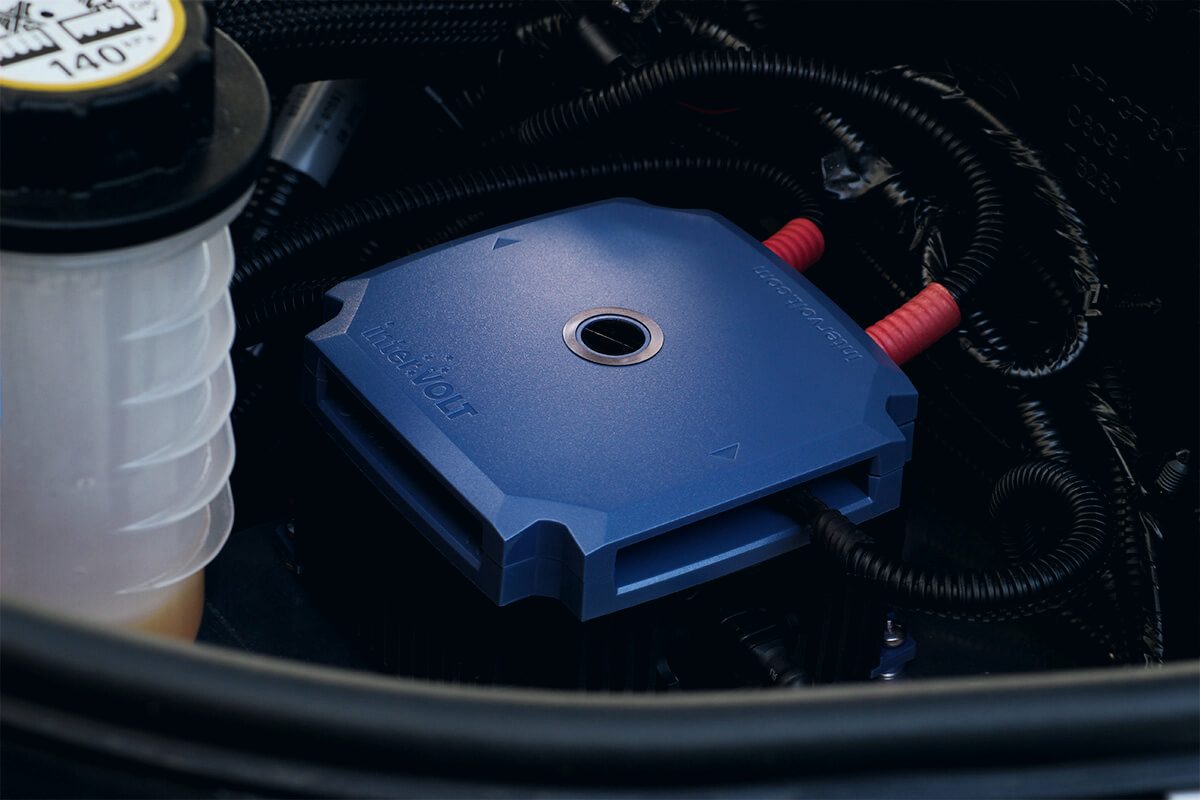
- Intervolt DCC Pro. An Australian-designed DC-DC charger with an MPPT solar input and a remote display. The display shows auxiliary battery voltage and charging current, which is charger status rather than a true state-of-charge reading, so pair it with a shunt monitor if you want to know what is left. Charge profiles for wet lead acid, AGM, gel, lead calcium and lithium iron phosphate.
- National Luna NLDC range. South African-made, DC-DC charging with MPPT solar built in and charge profiles across the same chemistries, with an optional remote monitor.
We sell both. Neither of them is the reason this page exists, and if what you have already does the job properly, keep it.
FAQ
Frequently asked questions
What does a dual-battery system actually do?
It separates the battery that starts your engine from the one that runs your fridge, lights and charging, so accessories can never flatten the starter battery. Better systems also charge the auxiliary battery correctly, which a simple relay may not manage on a modern vehicle.
Should I get a power station or a dual battery?
It depends on the load, not the budget. A fridge that runs every day wants a wired system that charges itself whenever you drive. Occasional trips, more than one vehicle, or a vehicle you would rather not drill point to a portable. Many people run both, with the fridge wired and the portable for everything else.
Do I need a DC-DC charger or is an isolator enough?
If your vehicle has a variable-output or smart alternator, if the auxiliary battery sits away from the engine bay, or if you are running lithium, you need a DC-DC charger. A voltage-sensitive relay may otherwise leave the second battery permanently short of full charge.
How long will my fridge run on a dual battery?
It depends on ambient temperature, how often the lid opens, how full the fridge is, and your battery's usable capacity, which is roughly half of rated capacity for AGM and much more for lithium. Work it out for your setup rather than trusting the figure on the box.
Is lithium worth the extra money?
Compare usable amp-hours rather than rated capacity, and the gap narrows considerably. Lithium gives you far more of its rated capacity, far more cycles, and less mass for the same usable energy, which matters against your payload. It needs a charger set for lithium.
Do I need solar?
Only if you stay put. If you drive every day the alternator does the work. If you base yourself somewhere for several days, solar changes the trip. Decide by how you actually travel rather than by panel wattage.
Last reviewed